
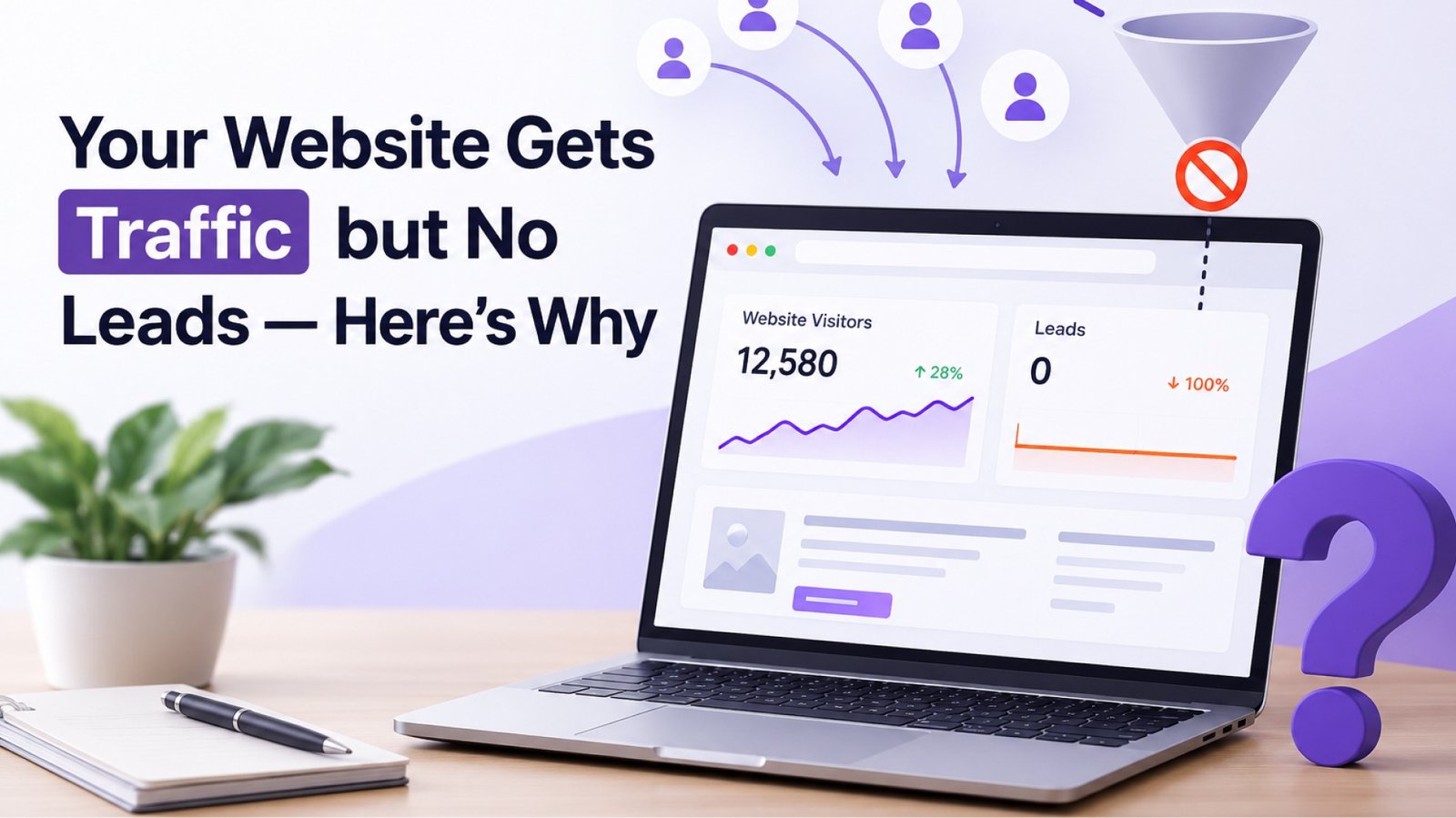
You’re getting website visitors. Your Google rankings are improving. Your analytics show people are coming to your site.
But there’s one problem: the leads aren’t coming in.
No enquiries. Few calls. Almost no contact form submissions.
If this sounds familiar, you may be tempted to invest in more SEO, increase your ad budget, or simply try to bring more visitors to your website.
But more traffic is not always the answer.
A website can attract hundreds or thousands of visitors and still generate very few leads. In most cases, the real problem is what happens after someone lands on your website.
Here are some of the most common reasons your website gets traffic but no leads — and what you can do about them.
1. You’re Attracting the Wrong Traffic
Not every website visitor is a potential customer.
For example, someone searching for “what is digital marketing?” may be interested in learning, but they may not be looking for a digital marketing agency.
On the other hand, someone searching for “digital marketing agency for small business” is much closer to making a decision.
This is why traffic numbers alone can be misleading.
Look at the keywords and pages bringing visitors to your website. Are they attracting people who actually need your product or service?
What to do: Focus your SEO strategy on a mix of informational, commercial and transactional keywords. Connect informational content with relevant service pages so visitors have a clear path toward becoming customers.
2. Your Website Doesn’t Clearly Explain What You Offer
Visitors should understand what your business does within a few seconds of landing on your website.
If your homepage headline is vague, your services are difficult to find, or your value proposition is unclear, visitors may simply leave.
You don’t need complicated messaging. You need to answer three basic questions:
- What do you offer?
- Who do you help?
- Why should someone choose you?
For example, instead of saying “We create digital experiences”, a clearer message could explain the specific services you provide and the business outcome you help achieve.
Your website should make the next step obvious.
3. There’s No Strong Call to Action
A visitor may be interested in your service but still leave because you never tell them what to do next.
A website needs clear calls to action such as:
- Get a Free Consultation
- Request a Quote
- Book a Call
- Get Started
- Talk to an Expert
Don’t hide your CTA at the bottom of the page and expect every visitor to find it.
Place relevant CTAs throughout important pages, particularly after sections where you have explained your service, benefits, process or results.
The CTA should also match the visitor’s intent. Someone reading an educational blog may not be ready to “Buy Now”, but they may be willing to book a consultation or explore a related service.
4. Your Landing Page Doesn’t Match the Search or Ad
Imagine someone searches for “Google Ads management services” and clicks an ad that promises Google Ads management.
Instead of landing on a dedicated PPC page, they arrive on a generic homepage.
That creates unnecessary friction.
The visitor now has to search through your website to find the service they were originally interested in.
Your landing page should continue the conversation started by the search query or advertisement.
If your ad talks about PPC management, the landing page should clearly explain your PPC service, benefits, process, proof and next steps.
This alignment can make a significant difference to conversions.
5. Visitors Don’t Trust Your Business Yet
People rarely submit their contact details to a company they don’t trust.
Even if your website looks attractive, visitors may still have questions:
Have they worked with businesses like mine?
Can they actually deliver what they promise?
What do their previous clients say?
This is where trust signals matter.
Consider adding:
- Client testimonials
- Case studies
- Reviews
- Industry experience
- Results and achievements
- Client logos
- Clear company information
- Relevant certifications or partnerships
Your website should not simply tell people that you’re good. Whenever possible, show them why they should believe you.
6. Your Contact Form Is Asking for Too Much
Nobody wants to complete a contact form that feels like a job application.
If your form asks for ten or fifteen pieces of information before someone can contact you, you may be losing potential leads.
Start with the information you actually need.
For many businesses, a simple form containing a name, email, phone number and brief requirement may be enough to start a conversation.
You can always collect additional information later.
The easier it is for a qualified visitor to contact you, the fewer unnecessary barriers you create.
7. Your Website Is Difficult to Use on Mobile
A large portion of website traffic comes from mobile devices. If your website looks great on a desktop but is difficult to use on a phone, you are potentially losing leads.
Check your website on an actual mobile device.
Can visitors easily:
- Read the text?
- Find your navigation?
- Click your buttons?
- Complete your contact form?
- Call your business?
- Understand what you offer?
A mobile-friendly website isn’t just about making the layout responsive. The entire experience should feel simple and effortless.
8. Your Website Is Slow
People don’t like waiting for pages to load.
A slow website can create a poor first impression and make visitors leave before they even see your offer.
Large images, unnecessary scripts, poorly optimised code, excessive plugins and hosting limitations can all contribute to slower performance.
Improving website speed can help create a smoother user experience while supporting your broader SEO and conversion strategy.
9. Your Blog Gets Traffic but Doesn’t Guide Visitors
This is a common problem with SEO-driven websites.
You publish useful blog content and start receiving organic traffic. But visitors read the article and leave.
Why?
Because there is no next step.
Your blog should not exist in isolation.
For example, an article about Google Ads can naturally link to your PPC service. An article about website design can guide readers towards your web design or development service.
Use internal links, relevant CTAs and useful recommendations to move visitors from information to consideration.
10. You’re Measuring Traffic Instead of Leads
Traffic is useful, but it shouldn’t be the only number you track.
If your website receives 10,000 visitors but generates only a handful of qualified enquiries, increasing traffic further may not solve the problem.
Instead, look at metrics such as:
- Conversion rate
- Contact form submissions
- Phone calls
- Consultation bookings
- Qualified leads
- Landing page performance
- Traffic source
- User behaviour
The goal isn’t simply to get more people to your website.
The goal is to get the right people to your website and give them a clear reason to take action.
How to Turn More Website Visitors Into Leads
If your website is already receiving traffic, start by improving what you already have.
Review your highest-traffic pages and ask:
Are these visitors the right audience?
Does the page clearly explain the offer?
Is there a strong CTA?
Do visitors have enough trust to contact us?
Is the page easy to use on mobile?
Can visitors quickly find the information they need?
Is there a clear next step?
Small improvements across these areas can make your existing traffic more valuable.
At LapaOne, we focus on more than simply driving visitors to a website. Our digital marketing approach combines SEO, PPC, website design, web development, social media and conversion-focused strategies to help businesses turn online visibility into meaningful business opportunities.
Final Thoughts
Getting traffic is only one part of digital marketing.
If visitors are arriving but nobody is contacting you, don’t immediately assume you need more traffic. First, find out why the people you already have aren’t taking action.
The issue could be your targeting, messaging, landing pages, CTAs, trust signals, website experience or lead capture process.
Fix those problems first.
Because the real value of a website isn’t how many people visit it.
It’s how effectively it turns the right visitors into real business opportunities.